
Watch your thoughts; they lead to attitudes. Watch your attitudes; they lead to words. Watch your words; they lead to actions. Watch your actions; they lead to habits. Watch your habits; they form your character. Watch your character; it determines your destiny. These words of unknown origin tell us that our silent and often subconscious choices shape our future. Every …
Our Business in Life
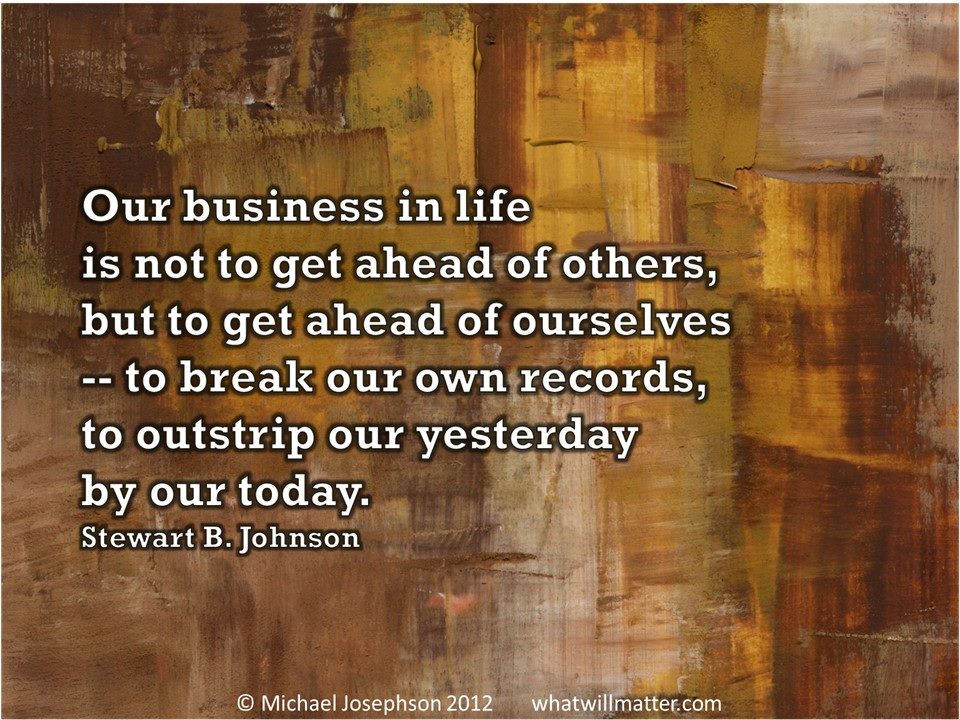
Our business in life is not to get ahead of others, but to get ahead of ourselves — to break our own records, to outstrip our yesterday by our today. – Stewart B. Johnson
COMMENTARY 795.3: The Self-Portrait Called Character
While I was on a radio call-in show talking about cheating, a listener I’ll call Stan mocked my concern. He cheated to get into college, he said. He cheated in college to get a job. And now he occasionally cheats on his job to get ahead. In fact, he concluded, cheating is such an important life skill that parents ought …
COMMENTARY 795.1: I Just Talk to People
Marta was a hard-working single mother. When her minister sermonized about “living a life that matters,” she worried that working to raise her kids and going to church wasn’t enough. So, on the bus to work she made a list of other jobs she could do and volunteer work she could try. Sylvia, an elderly woman, saw the worry on …
COMMENTARY 794.5: Doing Sports Right
When I was a kid playing sports, there were no clubs, travel teams, or private coaches. Except for summer baseball leagues, the primary place to play was high school. When I was in the 10th grade, I wanted to play basketball in the worst way. Unfortunately, given my size and talent, that’s how I played. But in those days, sports …
COMMENTARY 794.3: The Yuppie Lifestyle and Satisfaction
T.S. Eliot said, “Half of the harm that is done in this world is due to people who want to feel important. They do not mean to do harm…they are absorbed in the endless struggle to think well of themselves.” How do we feel important? Often, it’s by trying to obtain an image of success created by a culture that …
COMMENTARY: Living and Reading
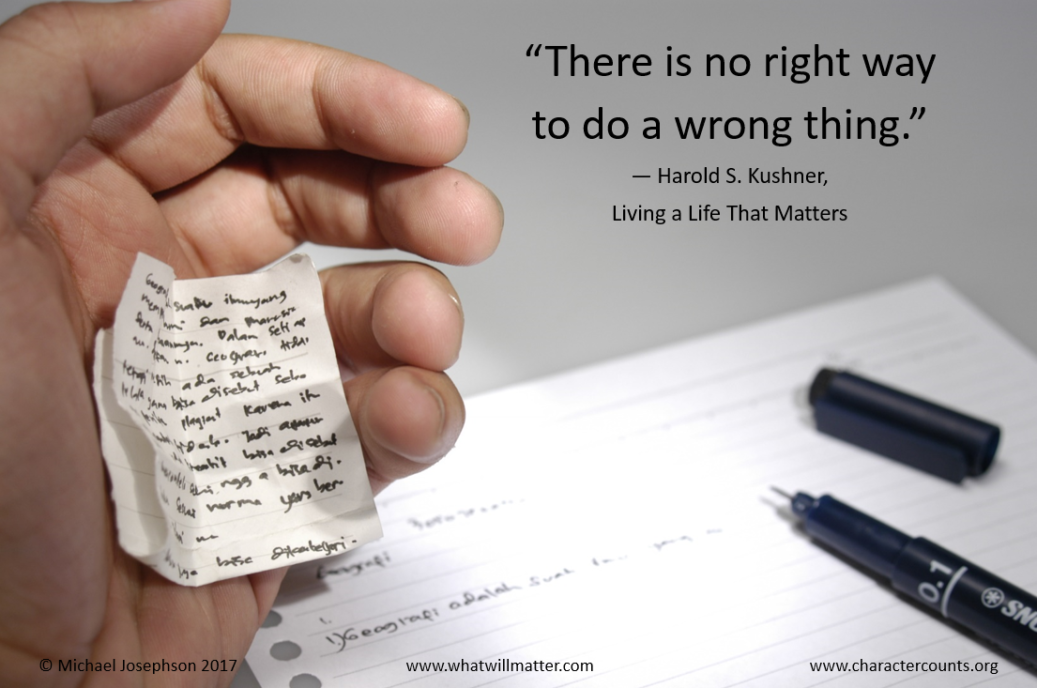
One of the most insightful and useful books I’ve ever read is a small volume by Harold Kushner called Living a Life That Matters. I’ll talk about the content of the book in future commentaries. Today, I want to suggest ways of getting the most out of books, at least non-fiction books, which is about all I read. Reading shouldn’t …
COMMENTARY 793.2: Kids Like to Win; Adults Need to Win
Whether you’re a sports fan or not, you have to acknowledge the powerful cultural influence that sports have on our culture. The values of millions of participants and spectators are shaped by the values conveyed in sports, including our views of what is permissible and proper in the competitive pursuit of personal goals. Professional sports and even highly competitive intercollegiate …
COMMENTARY 793.1: Tell Someone They’re Valued
The students at Sandy’s high school were badly shaken by the news that a classmate had killed himself. The suicide note said, “It’s hard to live when nobody cares if you die.” Glen, a teacher, realized this was a teachable moment about the importance of making people feel valued. He asked the class to imagine they were about to die …
COMMENTARY 792.5: The Journey Through Adolescence
One of the toughest jobs in the world is being a teenager. Everything is in transition. Everything is intense — even apathy. Kids on the brink of adulthood have to cope with inconsistencies and conflicts. The desire to be special and different clashes with the need to belong and fit in. The desire for independence collides with an aversion to …
COMMENTARY 791.5: Blessing Or Curse?
A man and his companion lost their way in a forest. The companion despaired, but the man said maybe some good would come of it. They came upon a stranger who needed the man’s help. The stranger turned out to be a prince who gave the man a beautiful horse. His neighbors praised his good luck and said, “How blessed …
COMMENTARY 791.3: Wisdom in 20 Words or Fewer: Part One
Since my children were small, I launched their day with the invocation to “be good, have fun and learn.” I hope they remember that mantra, but now that my daughter Samara is beginning her independent life as a college freshman 3,000 miles away, I think a more detailed set of maxims is needed. So, I’ve begun to assemble a collection …
COMMENTARY 790.2: Ramadan Kareem
Ramadan Kareem. Ramadan Mubarak. Kul ‘am wa enta bi-khair! (May every year find you in good health!) Please forgive my pronunciation, but I want to respectfully offer warm wishes and greetings to my Muslim brothers and sisters during the holy month of Ramadan. To those whose entire perspective of Islam and the Qur’an is shaped by fear and hatred of Muslim extremists …
COMMENTARY 789.3: The Illusion of Success
A common management strategy to spur achievement is to set aggressive performance objectives that, like the mechanical rabbits that pace racing greyhounds, push employees to maximum effort. Using “stretch goals” can be successful, but unreasonably high performance goals often spawn dishonesty and irresponsibility. Believing that “it’s a matter of survival,” a disturbing number of employees conclude that distortion, deception, and even …
COMMENTARY 789.2: Slow Dance
I once heard the chairman and CEO of a huge public company tell a roomful of ambitious, hardworking, dedicated executives that if he had to do it all over again, he would have spent more time with his family. That’s not news, but to Type-A personalities, it’s easier said than done. David L. Weatherford’s poem “Slow Dance” sends the message …
COMMENTARY 788.5: Are You Happy?
On a scale of one to 10 — with 10 being “It’s as good as it gets! I’m even happier than Charlie Sheen thinks he is,” and one being “Life sucks; it can’t get worse” — how happy are you with your life? Researchers say that when asked to grade their lives on a happiness scale, most people give a …
COMMENTARY 788.4: The Golden Rule as the Road of Honor
Five hundred years before the birth of Christ, Confucius was asked, “Is there one word that may serve as a rule of practice for all one’s life?” He answered, “Reciprocity. What you do not want done to yourself, do not do to others.” This basic principle, now called the Golden Rule, can be found in every major religion and philosophy. …
COMMENTARY 788.3: Delusions of Grandeur
Think of the most ethical person you know. Do a lot of people come to mind or only a few? Are you having trouble thinking of anyone? If I asked that question of the people who know you well, how many would name you? Almost all? About half? Just a few? Unless this commentary makes you more humble, you will …
COMMENTARY 788.1: Put the Big Rocks in First
There’s a well-traveled story about a teacher who showed his class a one-gallon jar and a dozen large rocks. After a little rearranging, he got all the rocks into the jar, filling it to the top. He then dumped a bag of gravel into the jar until the spaces between the rocks were filled. Next he poured sand into the …
COMMENTARY 787.4: A Call for More Civility
When George Washington was 16, he discovered a booklet of 110 maxims describing how a well-mannered person should behave. He was so convinced that these maxims would help him become a better person that he set out to incorporate them into his daily living. Among Washington’s many virtues, his commitment to civility marked him as a gentleman and helped him …
COMMENTARY 787.2: Shopping Carts and Rationalizations
When we think about character, we tend to think about big things like taking risks, acting with integrity, displaying generosity, or exhibiting self-sacrifice. These noble choices indicate character, but for the most part, our character is revealed in much smaller events like apologizing when we’re wrong, giving to causes we believe in, being honest when it’s embarrassing, and returning shopping …
COMMENTARY 787.1: How Much Do You Want It to Be?
A company was hiring a new CEO. After an extensive interview each finalist was asked one final question: “How much is two plus two?” Ann, an accountant, answered, forthrightly: “Four, of course.” Terry, who was an engineer, said, “It depends on whether you’re dealing with positive or negative numbers. The answer could be plus four, zero or minus four.” Chuck, …
COMMENTARY 786.4: Bringing Olympic Ideals Into Our Lives
I’ve talked before about the Olympic ideals upon which the modern movement was founded. Over the years, new words and symbols were made part of Olympism to reinforce those ideals. One of them is the Olympic Motto: citius, altius, fortius (faster, higher, stronger). Note that it’s not “fastest, highest, strongest” because the Olympic ideal encourages athletes to view success in …
COMMENTARY 786.3: The Not-So-Noble History of the Olympics
You don’t have to be cynical to note that none of the modern Olympic Games have consistently lived up to the noble goals of their founder. There’s too much nationalism, commercialism, overemphasis on medal counts, and explosions of pure ego. But before we despair about the imperfections of this grand effort to promote world peace and fair play, consider the …
The Rules of the Game, by Olympic Gold Medalist John Naber
Several years ago, Josephson Institute edited a book of 41 essays called The Power of Character. Among the accomplished and interesting contributors was John Naber, who won four gold medals and one silver medal in swimming at the 1976 Olympic Games in Montreal, setting four world records in the process. Now, with the London Games in full swing, we are pleased to …
COMMENTARY 786.2: History of the Olympics
As we view the spectacle of the 2012 London Olympics I want to share a condensed history of the Games. Legends differ on the exact reason, but it’s pretty certain that the first Olympic Games were conducted in Greece in 776 B.C. Thereafter, they were held every four years (called an Olympiad) for nearly 12 centuries. During the Games, a …