
Hi this is Michael Josephson with Something to Think About. Olivia Gardner was a sixth grader in Northern California when she suffered an epileptic seizure in front of her classmates. Immediately, the name-calling began. The hallway insults and ridicule – “freak,” “retard,” “weirdo” – escalated into cyber-bullying as a few nasty students set up an “Olivia Haters” website. One student …
COMMENTARY 779.3: Advice About Teens
Here are three suggestions for the parents of young teens, all learned through my own mistakes: First, remember, with emerging demands for independence, worries about peer acceptance, pressures of school and extra-curricular activities and a continuous search for self-identity, adolescents are on a physical and emotional roller coaster. Like every generation before them (including yours), young teens are often arrogant …
COMMENTARY 779.2: The Blue Stone and the White Lie
When my daughter Abrielle was 4, she came running down the hall screaming. “I don’t want to die! I swallowed a stone!” I immediately determined that nothing was obstructing her throat, but she was still in a panic. “It’s OK, sweetheart,” I tried to soothe her. “You’re not going to die.” She thought I didn’t understand. “But I swallowed a …
COMMENTARY 779.1: Dying From the Cold Within
One of the great challenges to our humanity is acknowledging and overcoming our natural tendency to think less of and discriminate against people who are different than us racially, ethnically, religiously or ideologically. Despite persistent rhetoric about prizing diversity, political debates often reflect disdain and contempt for those we disagree with and prejudices of all sorts are more readily stated. …
COMMENTARY 778.5: Learning From Pigeons
During an experiment, pigeons were put in cages with one green and one red button. In one cage, if the birds pecked the green button they would get food every time. In the other, the green button yielded food erratically and the pigeons had to persist to get enough food. In both cases, pecking the red button did nothing. Both …
COMMENTARY 778.4: The Best Dad
Years ago I heard a story of a dad named Paul who gave his young son a small chalkboard to practice writing on. One evening his son called out from the bedroom, “Dad, how do you spell best?” Paul answered him. Moments later, the boy hollered, “How do you spell kid?” Finally he asked, “How do you spell ever?” When …
SOMETHING TO THINK ABOUT FOR TEENS: A Teacher’s Dilemma About Grades
Hi this is Michael Josephson with something to think about. When I was a law professor, I administered multiple choice tests that I corrected by hand. One day, Ron came to my office informing me I made a scoring error – in his favor. I was impressed with his honesty and told him so as I was changing my records. …
OBSERVATION: How Can a Natural Pessimist Become More Optimistic?
Every full life has its bright days and its dark days, its triumphs and defeats, its calm and stormy seas. All these high and low experiences could justify viewing the past through the lens of gratitude or disappointment. And the way we characterize our history will determine whether we look toward our future with hopeful expectations or anxious trepidation. If …
SOMETHING TO THINK ABOUT: Lessons From the Monkey Pot
Many years ago a man came to a village in India to catch monkeys so he could sell them to zoos. The monkeys, however, were very clever and every sort of trap he set failed. A young boy watched the man’s pathetic efforts and laughed. The man said, “If you can catch me a monkey I’ll give you $2.” (That …

Who We Hurt The Most
Who We Hurt The Most “There’s one sad truth in life I’ve found while journeying east and west. The only folks we really wound are those we love best. We flatter those we scarcely know. We please the fleeting guest, and deal full many a thoughtless blow to those who love us best.” – Ella Wheeler Wilcox Subscribe to a weekly …
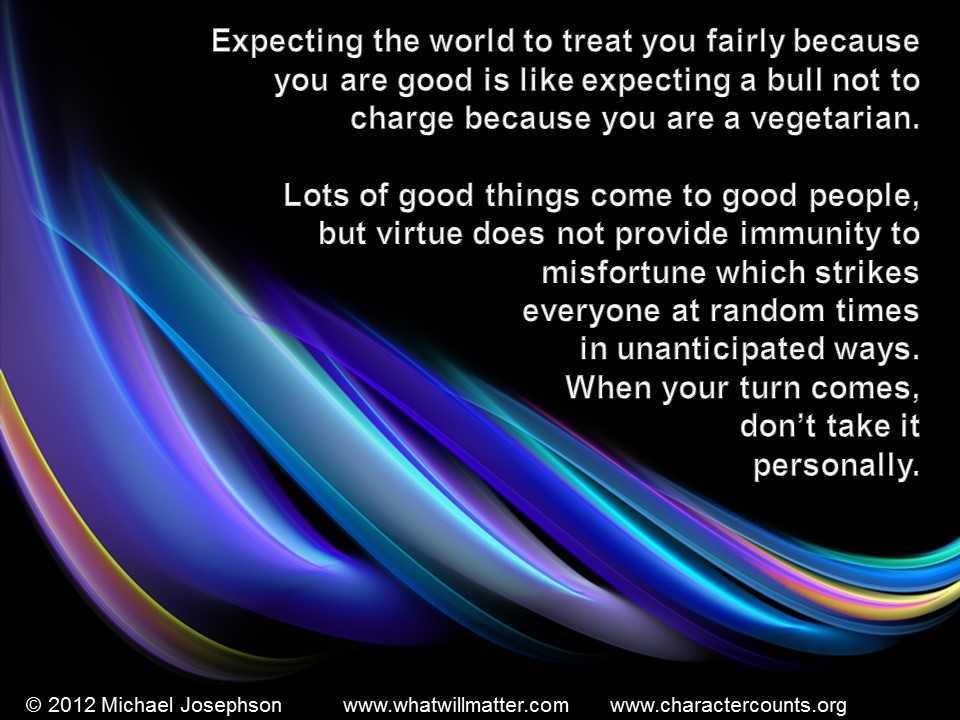
Virtue Does Not Provide Immunity
Expecting the world to treat you fairly because you are good is like expecting a bull not to charge because you are a vegetarian. Lots of good things come to good people, but virtue does not provide immunity to misfortune, which strikes everyone at random times in unanticipated ways. When your turn comes, don’t take it personally.
WORTH READING: How to Give Kind Criticism and Avoid Being Critical by Leo Babuta for Zen Habits
Why We Give Criticism Excerpted from Zen Habits To help someone improve. Sometimes criticism is actual honest feedback, meant to help the person we’re criticizing. We want to help them get better. To see a change that we would like. If we regularly read a magazine or blog, for example, there might be something that often bothers us that we’d …
WORTH READING: Ten Tips for Giving Constructive Feedback in the Workplace by Dr. Barton Goldsmith
10 Tips for Delivering (Constructive) Criticism by By Dr. Barton Goldsmith for Bankers Online Take an honest look at where you’re coming from. If there’s some anger or resentment toward the team member, then you’re probably not the best person to offer them advice. Start and end with a compliment. Find something good to say about your team member, this will help him …
OBSERVATION: One of the objectives of the Founding Fathers is captured in the expression of John Adams that the new American political system was to be based on “a government of laws, and not of men.”
In his 7th “Novanglus” letter, published in the Boston Gazette in 1774, John Adams introduced this phrase to the American discourse. According to Quotes and Counter Quotes, the concept of “a government of laws, and not of men” reflects a political philosophy that dates back to the ancient Greeks. But the phrase itself was enshrined in history and quotation books by John Adams prior …
OBSERVATION: Authentic constructive criticism must be motivated by a sincere desire to help, and delivered in a way that engenders gratitude rather than defensiveness or resentment.
If you want to be a positive force in someone’s life, it’s wise to remember that few people are truly open to criticism of any sort from any source. If you want to grow, understand more, and get better at whatever you do, it’s wise to be open to learn from every sort of criticism from any source. Implicit in …
WORTH READING: What is Constructive Criticism?
An excerpt from WiseGeek.com: Constructive criticism is criticism kindly meant that has a goal of improving some area of another’s person’s life or work. Often constructive criticism refers specifically to the critique of someone else’s written or artistic work, in perhaps a teacher/student setting, that would allow that person to further improve the work or to improve their approach to …
QUOTATION: “Take time to deliberate; but when the time for action arrives, stop thinking and go in”. — Andrew Jackson.
Contemplation and planning are important, but your life and its significance is shaped by action. Begin to do what you need to do. Begin to do what you want to do. Paint your future with the bold strokes of action.
WORTH SEEING: Poster – “You will never know how strong you are or how strong you can be until you lose something you really care about.”
Adversity will come and it will bring out the best or worst in you. Be ready. Be strong. Be better.
OBSERVATION: Life is difficult
M. Scott Peck said: “Once we truly know that life is difficult — once we truly understand and accept it — then life is no longer difficult. Because once it is accepted, the fact that life is difficult no longer matters.” His point is that we have a much better chance of finding happiness and contentment if we abandon our …
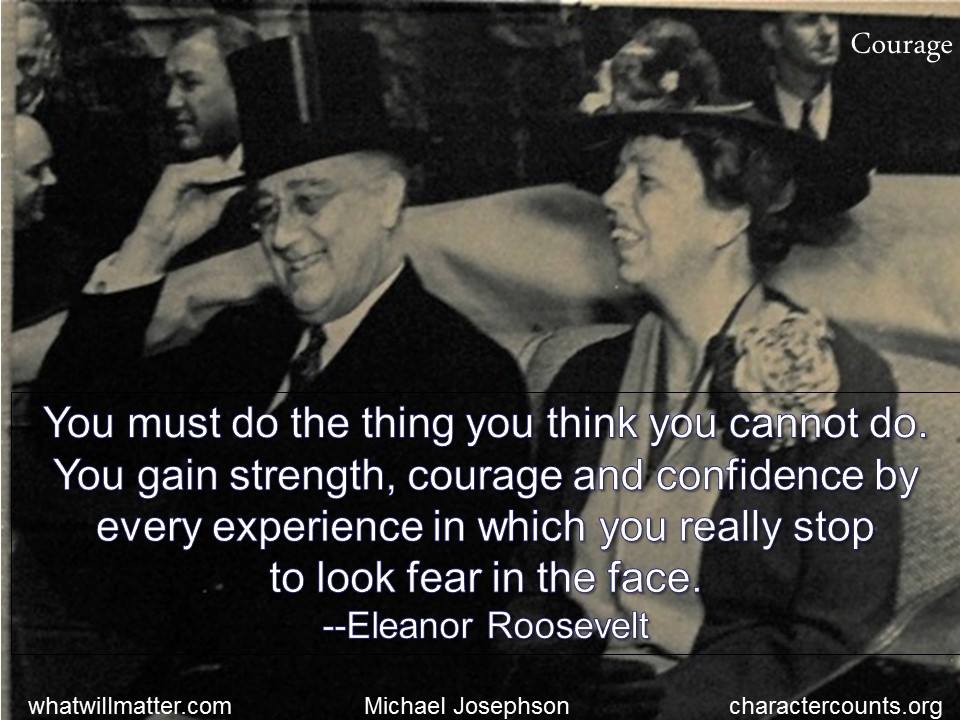
Strength, Courage & Confidence
You gain strength, courage, and confidence by every experience in which you really stop to look fear in the face. You are able to say to yourself, ‘I have lived through this horror. I can take the next thing that comes along.’ You must do the thing you think you cannot do. – Eleanor Roosevelt More images and quotes about …